Cultural Empowerment Framework - Ngwanake: An African-rooted approach to youth and community evaluation

Abstract
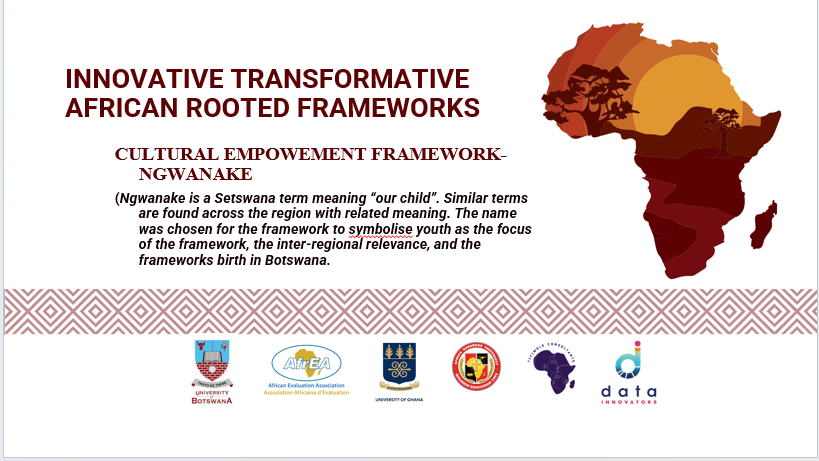
The Cultural Empowerment Framework; Ngwanake is an African-rooted evaluation approach developed through the Pan-African Indigenous Evaluation Consortium (PAIEC), with the participation of Africa Nazarene University and support from the Mastercard Foundation. The framework promotes youth and community empowerment by integrating cultural knowledge, indigenous practices, community science, and technology into project design, implementation, monitoring, evaluation, and learning.
Named after the Setswana term “Ngwanake,” meaning “our child,” the framework emphasizes three core principles: cultural awareness, cultural innovation, and autonomy or self-reliance (Jitegemee). It seeks to strengthen youth participation, amplify the voices of young women and local communities, address inequalities in decision-making, and promote culturally relevant, locally owned, and sustainable development interventions.
The presentation outlines the framework's application across project planning, design, implementation, monitoring, outcomes, and sustainability. It also documents pilot testing involving project designers, implementers, and beneficiaries in Zambia, Uganda, and Malawi. The pilot process identified challenges relating to gender inequality, youth access to finance and land, ownership rights, market access, and reasonable accommodation for persons with disabilities. The framework highlights the potential of intergenerational learning, indigenous knowledge, cultural innovation, and appropriate technology to support community-led evaluation and sustainable development.
The framework was developed as part of the broader initiative to strengthen African-led approaches to monitoring, evaluation, and learning.
Publisher
Africa Nazarene University
Subject
Indigenous evaluationYouth participation
Cultural empowerment
Community engagement
African indigenous knowledge
Monitoring and evaluation
Monitoring, evaluation and learning (MEL)
Community ownership
Cultural innovation
Youth empowerment
Development evaluation
Evaluation frameworks
Digital technology
Sustainability
Ngwanake
African-led development
Mastercard Foundation
Collections
Related items
Showing items related by title, author, creator and subject.
-
Critical Evaluation of the Role of Faith Based Organizations Peace Building in Juba, South Sudan
(Africa Nazarene University, 2017)Civil war has destroyed the infrastructure as well as disrupted the development of South Sudan as a country. Faith based organizations role in conflict resolution and peace building in South Sudan has been in existence for ... -
An Evaluation of Churches’ and Church-Based organizations’ roles in enhancing food security in Turkana District
(Africa Nazarene University, 2009)This study was carried out in Turkana district where people have been dependent of food handouts for many years. The district leads in the number of churches and church-based organizations working on various programs to ... -
An evaluation of selected communication styles on organizational change in dairy farming industry in Kenya: A case study of Brookside dairy limited, Ruiru.
(Africa Nazarene University, 2012)Any company should look at the organizations overall vision and objectives, then suggest how communication can help deliver these goals, as well as referring to specific objectives. Though it may be taken for granted that ...